📅 Welcome to the Blues Guitar Lick Advent Calendar 🎸
🔥 24 Blues Licks to improve your phrasing, technique, ears, and improvisation!
Sign up late? Don’t worry, you’ll get access to all 24 licks no matter when you register.
Get Started
Watch the Overview
This was the announcement video I made for YouTube; however, at around 1:40, I break down the backing track and share some essential information about the licks, which I recommend you watch before getting started.

Join the Discord server! 🎸
To help you get the most out of these licks, I’ve added them to the free area of our Discord server. While you’re working on them, you can interact with everyone else who’s tackling the same ideas and get feedback from me as well.
It’s where other players are working through the exact same challenge, posting their progress, asking questions, and sharing ideas. You’ll be able to learn alongside them, get quick feedback, and stay motivated.
Our Discord is free to join, and it’s the centre of everything we do in the Guided Practice Routines community. Inside, you’ll find dedicated channels for blues, technique, gear, general chat, and more, plus direct access to me and the rest of the community. It’s easily the best way to stay connected and make real progress.
🎄🎸 The Blues Guitar Lick Advent Calendar 🎸🎄
Day 1 - Simple Blues Phrase
This lick is built around a simple two-part idea that works like a question and an answer. The opening statement rises at the end, the same way your voice naturally lifts when you ask a question. When the second half comes in, it begins with a similar shape but resolves with a descending line, which gives it that grounded, spoken-answer kind of feel.
There are a couple of musical colours woven in too. I use both the minor and major third, but not in an obvious “mixing major and minor” way. The minor third functions more like a passing tone leading directly into the major third, so the overall sound stays firmly major while still carrying a bit of that bluesy flavour.
You’ll also hear the major sixth, that F sharp, in the opening ascending figure. It adds a smooth, melodic quality that you wouldn’t get from the minor pentatonic or from strictly thinking in terms of a basic arpeggio. If you built the line from the minor pentatonic, you’d land on a G there instead, which has a very different contour and doesn’t feel as fluid. I still use the G when I want a touch more tension, since it gives me a mild dissonance to play with, and it comes in handy when the harmony shifts underneath. As the chords move, that G helps the line follow the changes in a really natural way.
Day 2 - Double Stops 101
Lick number two leans into a really essential double-stop idea, the kind of thing you’ll hear from everyone from Stevie Ray Vaughan to Zakk Wylde. It comes from barring across two strings at a time and creating these gritty, harmonised hits. I’m presenting it here as more of a study, but once you get comfortable with the shapes you can use them for riffs, fills, and soloing. When these patterns become second nature, you can sequence them just like you would a scale and turn them into hooks. There’s a lot of mileage in this one concept.
The main challenge is accuracy. In the example I’ve kept things clear and controlled so every double stop rings cleanly. It’s also worth practising this idea in a slightly rougher way, where you clip a few muted strings on your way through. That extra bit of noise adds character and can give the phrase some of that “starch in the gumbo” feel that works so well in blues and rock.
Another benefit of this lick is that it trains you to move smoothly between strummed double-stop textures and precise single-note playing. That contrast is exactly how these ideas show up in real songs and solos, and it’s equally common in styles like funk and gospel guitar. Getting comfortable with that transition will take your phrasing a long way.
Day 3 - 6s & Suspensions!
Lick three is another example of question and answer phrasing. I open the statement with a slide straight into a bend. This takes a bit of coordination and good intonation, so really commit to it. One of the biggest pitfalls here is being timid and picking the note too softly. We want this to come across loud and confident, so even while you’re still getting the movement under your fingers, don’t train the timid version of the phrase. Go for it.
For the call and response element, the answer uses a technique called octave displacement. The question is a two-bar idea that’s mostly descending. When the answer comes in bars three and four, I start the same way, but the ending in bar four jumps up an octave and echoes the shape from the first ending. You’ll also notice I don’t play the exact same notes. Instead the pull-off from D to C#, I start the octave displaced section with a quarter tone bend from the minor third. I’m thinking about how I want to treat these notes in different octaves, and I’m not being overly rigid about copying the exact fingering from the lower register.
I could have played the same ending phrase an octave higher, and it would have worked fine, but this variation brings a bit more personality and also suits what’s comfortable in this position and range. It keeps the idea familiar while still giving the answer its own identity.
Day 4 - Double Stops Mark II
Lick four builds on the double-stop material from lick number two, but this time I’m breaking it up with a pedal note. A pedal note is simply a repeated or reference pitch that you drop in throughout a phrase. It creates this ping-pong effect, and you’ll hear it all the time in riffs where a low note keeps pulsing underneath while something melodic or chordal happens on top. That’s exactly what’s going on here.
The same challenges apply as before. You want to be really clear with your picking and muting so the double stops speak cleanly. The moment any of these notes start ringing into each other without control, the whole idea can fall apart and turn into a noisy mess. Aim for clarity first, then add attitude once the mechanics are solid.
You’ll also notice how I end the phrase with that same ascending melodic figure from the first lick. This is such a versatile melodic fragment that can open or close ideas.
Day 5 - Classic Fast Blues Rock
Lick five is another one of those incredibly versatile melodic fragments. This opening figure is such a staple of the blues vocabulary that I’m honestly surprised it took us until day five to get to it. It’s a five-note sequence that starts with the bend at the seventh fret of the G string and ends with the pull-off to the fifth fret on the B string. The interesting thing is that this little loop actually takes a beat and a half to complete, so every time you repeat it, it shifts. It won’t always start on the downbeat, and it won’t always land on the same part of the bar. That phasing quality creates a really cool rhythmic effect.
The lick itself is fairly straightforward, and you’ll see some familiar themes in how I’ve put it together. I’ve taken this classic idea and given it two strong endings. The reason is simple. Most players know this lick, but many only know how to exit it one particular way. Great players can take a fragment like this and dismount at any point, heading in any direction they want.
So in this study, I’ve given you a way out at the lower end by descending onto the D and A strings in the second bar, and a way out at the upper end by sliding up the position in bar four. Both approaches teach you how to leave the sequence cleanly and musically.
Play around with it exactly as written, then start shifting the rhythm, experimenting with different placements, and creating your own escape routes. The more options you develop, the more freely this idea will flow in your improvising.
Day 6 - Open Position Country Rock
Lick six is our first real departure from that fifth-fret area that so many of you are comfortable navigating in the key of A. We’re dropping down toward the second position, which, if you think in CAGED terms,is the G shape. This is an excellent place to build blues vocabulary because of how naturally the notes fall under the fingers.
The challenge is that most guitar players get fixated on the high notes in this position and overlook the inner and lower strings. Those strings are actually some of the best places to explore. You can find great bending notes, smooth slide-in notes, and all sorts of musical transitions that sit really nicely under the fingers.
With that in mind, start building some vocabulary in this G shape. If you number your pentatonic positions one through five, this lines up with the fifth position of the minor pentatonic. In the second half of the lick, I drift down into the open-string area as well. You can transpose the whole thing by shifting your hand and recreating the shapes, or you can treat the lick as two separate sections and focus on transposing just the first bar, which only uses fretted notes.
Both approaches are worth practising, and both will open up this region of the neck in a big way.
Day 7 - Fast Open Position Rock
Lick seven continues our exploration of the lower fretboard regions in the key of A, and more specifically how we can use open strings inside a line. This one leans a bit into my country influences, and I hope that flavour comes across clearly while still sitting comfortably and stylistically over the backing track. Don’t be afraid to see what country vocabulary you can borrow for your blues and rock playing. Plenty of great players blend those worlds beautifully.
Beyond just being a fun lick, this is also a really solid positional study. It covers one of the most common ways country players navigate the neck, using a mixture of fretted notes, open strings, and slides to move through positions smoothly. Learn this almost as if it were a scale shape with a built-in position shift. That idea isn’t unusual at all—Segovia taught scales with shifts, and country players do the same thing for exactly the same reason.
Once you’re comfortable with the mechanics, start treating this lick like a scale you can improvise from. Create your own melodies, sequences, and variations using the same framework. That’s when this approach really comes alive.
Day 8 - Open Position Double Stops
Lick eight is an exploration of some of the double-stop ideas available in this position, and it shows them in more of a riff-based context. The key takeaway here is how I’m combining double stops with something closer to a bass line that outlines the chord. That little walk from C to C sharp on the A string, along with the final notes at the end of bar three leading into bar four, gives the part a nice sense of forward motion and melodic interest.
Instead of just strumming power chords, look for ways to blend double stops with single-note movements to embellish your rhythm playing. This approach helps you create guitar parts that feel more crafted and melodic, rather than just blocks of chords. It’s a great way to add personality and musicality to even the simplest progressions.
Day 9 - Slower Open Position Phrase
Lick nine brings us back into that question-and-answer phrasing we all know and love in blues. We’re once again in position five of the minor pentatonic—the G shape in the CAGED system—and this lick highlights a couple of the classic blues movements available in this spot:
• The slide on the B string that takes you from the flat third up to the major third
• The bend on the fourth fret of the G string that pushes the second degree up toward the third
When you’re practising this lick on its own, or treating it as a source of scale ideas, experiment with that bend on the G string. You can bend it to different places and explore how you want to interpret the third depending on the notes before and after it.
This phrase is also a great example of how powerful simple rhythms can be. I’m mostly using eighth notes, quarter notes, and a bit of sixteenth-note movement, but I’m placing them in a very deliberate, logical way. The question starts with eighth notes and then settles into longer values, which grounds the line. In the answer, I come back to the eighth-note feel, but instead of giving you exactly what you expect, I shift up a gear into sixteenths.
Most people think of call-and-response in terms of how the notes or melodies change, but it’s just as much about how the rhythms balance each other. You set up expectations with the question, then you can play against those expectations in the answer to create tension, movement, and a bit of intrigue.
Day 10 - Open To E Shape Shifting
Lick ten brings together many of the concepts we’ve already explored, and everything I mentioned earlier about treating a position like a scale shape you can make melodies from applies here too. All of that positional thinking still holds.
One of the big challenges in this example is balancing the articulation between open strings and fretted notes. Getting an open string to flow naturally into a fretted note—or hammering on with the first finger and pulling off to an open string in a musical way—is something a lot of players struggle with. If that transition isn’t smooth, it can break the flow of the entire phrase.
So when you practise this lick, work on the position, work on the rhythm, work on everything we’ve talked about so far, but also really focus on ironing out the kinks between your open-string playing and your fretted playing. That detail alone will elevate how fluid your lines feel.
This lick also includes some nuanced bending that you’ll want to dial in for an authentic blues sound, especially toward the end when I shift up to the fifth position. And that brings up the other major challenge: shifting positions smoothly and musically. Pay attention to how the guitar feels in different parts of the neck and adjust so the shift doesn’t feel abrupt or disorienting. When the positions blend seamlessly, the whole line breathes much more naturally.
Day 11 - Slash Style Sus Arpeggio
Lick eleven is a bit of a finger-twister. There are some awkward shifts and slides in here that you’ll want to work on slowly at first so that, when you bring it up to speed, you don’t lose any of the articulation or clarity.
It also outlines a really nice C-shape arpeggio for the A chord around the ninth position. You’ve seen me reference this before and you’ll see it again. It’s a bit of an unsung hero on the fretboard, so spend some time there and see what kinds of melodies you can build from that shape.
This phrase also leans into a very typical blues idea: starting with a more major flavour in the flowing, melodic opening, then grounding the line with more “minor” sounding blues thirds at the end. Those blues thirds aren’t just flat thirds, though. They’re flat thirds with a slight quarter-tone bend on them. Listen to how I contrast the strong major Mixolydian vocabulary in the opening with the closing tag, where those C notes are bent just a little sharp. That’s one of the key ways we can use the Mixolydian scale in a blues context without it sounding too jazzy, by tying it back to the character of the blues.
Day 12 - Slick Herring Fusion Blues
I think it’s pretty obvious what the main talking point of this lick is, and that’s the bend–release–slide–bend figure that opens the statement. Even though that move is front and centre and very ear-catching, it’s important to remember that if what followed it wasn’t confident blues playing, the whole thing would fall flat. No matter how good your “bendy-ness” is, it doesn’t mean much if you do not stick the landing.
I like to think of it like hitting a home run in baseball. The big hit is only half the story. You still have to run around the bases to actually score. That is exactly what is happening here. The flashy opening move is the big hit, and the strong blues motif that follows is you running the bases and bringing it home.
When you work on this lick, really listen to how I perform that slide and bend. Notice how it moves through clear stages rather than turning into a messy blur. It is a very deliberate sequence. Take it as slowly as you need to so you can control three things: pressure, timing, and intonation.
Too much pressure and you will not be able to move smoothly, and you could even hurt yourself. If the timing is loose, the lick loses its impact and just sounds like you are fishing for the note. And if the intonation is off, the whole thing simply sounds out of tune. Get those three elements under control and this opening figure becomes a powerful tool in your vocabulary.
Day 13 - Simple 6ths Lick
Lick thirteen builds on everything we’ve already covered about double stops and brings in the second most common type you’ll hear in blues, rock, and country: sixths. These are the double stops you see in the second and fourth bars of the phrase. They’re beautifully melodic, and because of how they’re constructed, they outline the harmony and chord movement in a really natural way.
In this example, I’m using the sixths as a kind of counter-phrase to the more traditional double stops we’ve already explored. You can really hear the contrast between the crunchier, tighter intervals in the standard double stops (bars 1 and 3) and the much more open sound you get from the sixths. That difference comes straight from the interval itself. The notes in a sixth are six scale degrees apart, which is a much wider gap than the thirds and fourths we’ve used before, and that wider spacing translates directly into a more open, airy sound.
Listen to how those contrasting textures play off one another across the phrase. It’s a great way to balance density and openness, and it’s one of the reasons sixths show up so often in melodic and expressive guitar playing.
Day 14 - Full 6ths Lick
If lick thirteen lit a spark for sixth-interval double stops, then you’re in luck, because lick fourteen is the next logical step. This one is built entirely from sixths. It still works as a beautiful, bluesy phrase on its own, but it’s also a fantastic positional study. You can almost treat it like a scale shape made out of double stops, something you can mine for melodies, countermelodies, and riffs.
When you start exploring it that way, remember to treat sixths just like you would any other scale material. Play with the rhythm, break them up into single notes, play them together as full double stops, and experiment with chromatic approaches, slides, and all the creative touches you naturally use in your single-note lines. The more freedom you develop with these shapes, the more musical possibilities open up.
Day 15 - BB King Box Lick
Lick fourteen opens in that very familiar BB Box shape, which I’m sure you all know and love. I didn’t want to give you a straight-up BB-style lick here, because most players who’ve spent any time in this position already have a few of those under their fingers. You can usually hear it too: they sound like Stevie Ray Vaughan in position one, and the moment they slide up into the BB Box, they suddenly sound like BB King. Both of those things are great, but I wanted to highlight that there are many ways to play around this position without flicking that automatic “BB switch.”
So that’s what I’ve done here. After the traditional opening phrase, I shift into that D-shape idea I love so much — the fourth down to the major third of the key. In this case, that’s the D down to the C sharp at the tenth and ninth frets on the high E string, before moving down through the rest of the D-shape arpeggio. And when I reach the G string, instead of just hitting the C sharp at the eleventh fret cleanly, I give it a bluesy slide from a half-step below. Little touches like that go a long way in blending arpeggio and Mixolydian vocabulary with the standard BB Box ideas.
From there, the phrase breaks out of the box entirely and drops down onto the D string, giving you a hint at how you can get bluesy lower in the position too. That’s an important mindset shift. The BB King Box is fantastic, but we should always be looking for ways to connect it to the surrounding positions and to the rest of the ideas we want to express. Players like Robben Ford live in the BB Box all the time, yet they never sound like they’re just quoting BB. They’re tying that position into a much wider palette.
Now that you know some additional notes and pathways in this area, try soloing over the backing track in the BB position while blending in some Mixolydian and arpeggio vocabulary. See if you can begin to sound less like BB and more like you when you’re up there.
Day 16 - C Shape Chromatics
Lick sixteen is another example of how to stay in the BB Box without sounding like a BB clone. I start with a classic BB-style opening phrase and I finish with that trademark hit on the seventeenth fret. But the key is what happens in between. I add a jazzier chromatic run that climbs from the third to the fifth of the chord on the high E string. That little ascent makes the whole idea less predictable and opens up a different colour.
Even with that chromaticism, I’m still leaning heavily on chord tones, which keeps everything grounded in the blues language. You still get that classic minor third to major third sound, so it remains very much a blues phrase — just one that leans toward the jazzier side of the spectrum.
Day 17 - A Shape Robben Ford
Lick seventeen continues our exploration up the neck. We’re now moving into the next position at the twelfth fret, which lines up with the A shape in the CAGED system, or position four if you think in minor pentatonic numbers. You’ll hear the familiar bends from the flat third — that C at the thirteenth fret — but there’s another interesting colour here: I’m really leaning on the F sharp at the fourteenth fret of the high E string.
That note isn’t part of the minor pentatonic scale. It belongs to the major pentatonic. And when you combine that F sharp with the C, the flat third, you get a tritone interval. We usually think of the tritone as the flattened fifth blues note, but mixing the minor and major pentatonic scales also creates a tritone between the flat third and the major sixth. It’s a modern, ear-catching sound, even though it has been around for centuries.
I love phrases that combine the minor or bluesy third with the major sixth. If you’re familiar with the Dorian mode, that sound will be immediately recognisable because it’s one of the hallmarks of the Dorian flavour. So you can absolutely take ideas like this and use them over any of your Santana-style jam tracks or grooves with a similar vibe.
In this lick, I go from the C to the F sharp via a bend and the E at the twelfth fret. That little detour doesn’t hide the quirkiness of the phrase; it just gives the tritone colour a softer landing. The pungency is still there, but it sits inside the line in a more melodic, less confrontational way.
The whole point of this lick is to show those of you who rely heavily on position three of the minor pentatonic that there’s a “hidden” note at the fourteenth fret. It isn’t in the minor pentatonic scale, but you can fold it into your minor blues vocabulary to get a much hipper, more colourful sound. Use it tastefully, and it adds something really special.
Day 18 - BB King Meets Albert King
Lick eighteen will expose a lot of timid or underdeveloped benders out there. The phrase starts simply enough, using minor language around the BB position at the tenth fret, but there are a few subtle nuances and technical hurdles in the bending that you need to be aware of. One of the biggest challenges is the bend that happens immediately after the position shift. That bend has to be powerful and perfectly in tune or the whole statement loses its impact. Right after that you have a first finger bend. This idea comes straight from Albert King, and he made these bends look effortless. Physically it will not be effortless for most of us, and these bends will take work, but the goal is to use only the minimum force that you need rather than brute strength.
I have noticed that many players tense up before they even attempt the first finger bend. They anticipate the difficulty, get anxious, and their whole arm locks up. Watch out for that. Practise placing your first finger, staying completely relaxed, and not bending at all. Get used to the feel of being calm in that position. Then gradually add the bend back in, making sure you are not tightening up or bracing in anticipation.
The other crucial part of this lick is vibrato technique, especially vibrato with the first finger. Just like bending, first finger vibrato is a real sticking point for a lot of players. Plenty of people have a lovely, wide vibrato with their third finger, sometimes even their second finger, but when it comes to the first finger the vibrato suddenly becomes narrow and timid. Some players even avoid ending phrases on the first finger so they can finish with a bigger vibrato on a stronger finger.
We do not want our melodies to be dictated by our technical weak spots, so we need to develop both first finger bending and first finger vibrato. Listen to how I vary the vibrato in this lick. I use different speeds and different widths to add life and variation to the phrase. Also notice that I am not afraid to vibrato downwards toward the floor even though I am on the B string. Experiment with what feels natural, then double-check that it sounds right, and you will be moving in the right direction.
Day 19 - Charlie Parker Bebop Blues
Lick nineteen is a great demonstration of how I like to approach blues articulation, especially if you enjoy faster lines. This lick is mostly sixteenth notes, and there are a few key concepts at play here that will help you make fast phrases sound musical rather than like you are simply rushing through scales.
The first idea is all about the picking hand. My picking hand is constantly moving in a down and up sixteenth note motion and either striking the strings or passing over them depending on whether I want a note to sound. Whether I am making contact or not, the motion never stops. This locks in my time feel, creates consistency in how loud or soft the notes are, and turns me into what I like to think of as a dynamic sharpshooter. I always know that my downbeats will be downstrokes, and the syncopated sixteenth notes, such as the second and fourth sixteenth of each beat, will be upstrokes. So when I want to add accents, I know that accenting on my upstrokes will naturally highlight those hip syncopated parts of the phrase. It keeps me in time, it keeps the line flowing, and it makes accenting clear and intentional.
The second concept is how I use slides on strong beats. Earlier I mentioned accenting with upstrokes on the syncopated notes, and those accents sound even stronger because the downbeats are actually softer. Look at how I slide into beat three, and then slide into beat one of the second bar. Those slides reduce the dynamic level on the strong beats, so the syncopated accents stand out beautifully. This is very tactical. By placing the slides and position shifts on the strong beats, I bring even more attention to the rhythmic feel. When you are playing a line that is continuous sixteenth notes, this is a crucial part of keeping things interesting and musical.
The final piece is how I target chord tones. Look at the first note of each beat in the first bar:
• Beat 1 is G, the flat seven of A
• Beat 2 is E, the fifth
• Beat 3 is C sharp, the major third
• Beat 4 is A, the root
I do not hit a non-chord tone on the downbeat until the second bar when I land on F sharp. Even that is still a strong melodic choice because it comes from the major pentatonic scale.
So what might look like a flurry of sixteenth notes is actually a phrase that is carefully shaped both dynamically and harmonically. With practice you will be able to improvise with these concepts in real time. I recommend starting by writing a few licks that use these techniques so you can build a feel for them. Over time the ideas settle into your playing, and one day they simply appear when you need them.
Day 20 - Jimmy Herring Fusion Blues
Lick twenty is really about the big bends. We have a tone and a half bend here, and although many players will already be familiar with it, if you are new to this technique then this is a great lick to get you started.
As a quick side note, if you struggle with bending or feel underpowered, practising bends between the twelfth and seventeenth frets is a great way to build strength. A lot of players learn the A minor pentatonic scale at the fifth fret and immediately try to bend there. The closer you are to the nut, the harder it is to move the string because you are closer to the anchor point. So if your hands are tired or you simply want more reps, work on your bends in this higher region of the fretboard.
Beyond the obvious challenge of the opening bend, the other important thing about this lick is the strong, resolved closing statements. Isolate the ending sections of these phrases and add them to your vocabulary. Just as you want a collection of powerful opening phrases that feature big bends, you also want a vocabulary of satisfying ways to end your ideas in different positions. These endings should feel grounded and should be something you can articulate and inflect with confidence.
So practise the difficult parts, such as the big bends and the slippery quick notes, and also steal the ending portions of the phrases. Then start experimenting with creating different lines that flow into those endings.
The ending in bar two, where I jump up to the A note at the fourteenth fret, is a classic way to finish a phrase. You run down the scale and then, instead of simply stopping at the bottom, you hit the root note in a slightly higher octave. It is simple, strong, and very musical.
So start playing around with that and see how many of your own phrases you can land using that approach.
Day 21 - Don't Forget The Classics!
By now you are probably feeling very confident with the double stops around the fifth position. This lick adds a very common double stop that you can mix into the earlier material to create some really cool lines and riffs.
The double stop I am talking about is the E at the ninth fret of the G string paired with the G at the eighth fret of the B string. It is a crunchy and meaty sound because it features the flat seven of the chord, and that interval has a beautiful rub to it.
Another great thing about this shape is how easily the fingerings flow. Even though this lick shifts you from the area around the fifth fret up into the seventh fret region, it still feels seamless because these double stops connect the positions so naturally. That makes them an excellent tool for transitioning between pentatonic positions, especially when you are moving from position one into position two. You can use these double stops, or simply the notes inside them, to smooth out that shift.
This approach is exactly how Stevie Ray Vaughan would use the notes in this part of the neck. And just like in the previous lick, the moment I finish with the double stop material, I ground the line with a solid closing statement. I actually give you two different endings here, one the first time through and a different one the second time through, so you have two strong closing ideas you can extract and add to your vocabulary.
Day 22 - Fast Triad Pairs
Lick twenty two can be described very simply, but it can also be a doorway into much more complex and sophisticated concepts. At its core, all I am doing is climbing the fretboard and alternating between G triads and A triads. I begin with a G triad, shift up to an A triad, then shift up to another G triad, then another A triad, etc.
The great thing about this idea is how easy it is to visualise. Both triads are major, and they are only a whole step apart (G to A), which is two frets. I start with a root position G triad, then slide the exact same physical shape up two frets to get a root position A triad. I then play the next inversion of G, and again, to turn that into an A triad I simply slide the shape up two frets. Once you begin to dissect it, the pattern becomes very clear.
If you want to take this idea further, you can think of it as outlining a pair of arpeggios within the key. From there, you can choose any two arpeggios from the key and start building your own vocabulary by outlining those. If you want to go deeper, look up triad pairs or diatonic harmony and superimposition. Those topics open up an entire world of modern melodic concepts.
To give you a simple launching point, we are in the key of A7 or A Mixolydian, which is the same set of notes as D Major. They are relative to each other. That means you can use any of the diatonic triads from D Major: D Major, E Minor, F sharp Minor, G Major, A Major, B Minor, and C sharp Diminished. I chose G and A because major triads have a strong, clear sound that works beautifully for melodic lines. It’s also a very traditional, go-to sound. The G triad also creates tension because its notes function as extensions over A. The G note is the flat seven, the B note is the ninth, and the D note is the eleventh. So the G triad contains non chord tones that create colour. When you follow that with an A triad, which contains the root, third and fifth of the chord, you get a strong sense of release.
In other words, every time I alternate between G and A, I am moving from tension to release. That back and forth creates forward motion and gives the line a satisfying internal logic.
Day 23 - 16th Note Fusion Blues
Lick twenty three shows a very elegant way of connecting positions using slides with the first finger on the high E string. In this example I use it to connect positions in a descending direction, although you can use the exact same idea to climb the fretboard in an ascending way. It also has an interesting rhythmic feel because I am playing continuous sixteenth notes, yet the position shifts land on a three note pattern. That grouping of three displaces against the steady sixteenth note subdivision and creates a sense of forward motion and rhythmic interest. If you accent or mentally group your notes in threes, you get a phasing effect that some people describe as a polyrhythmic feel, since the accent keeps shifting against the underlying four four groove.
This lick also highlights some interesting shapes and note choices. Look at the opening five notes where I play B, C sharp, E, G, and then B again in the higher octave over A7. This outlines the sound of an A9 arpeggio, which is a beautiful colour to imply over a dominant chord. The ninth is a very sweet note that a lot of blues players lean on because it creates a very open and consonant sound.
If you enjoy digging into theory, you might also recognise those opening five notes as outlining a C sharp minor seven flat five arpeggio. In the previous lick I talked about experimenting with different arpeggios from within the key, and this is very close to that concept. C sharp minor seven flat five is one of the diatonic seventh arpeggios that exists inside the world of A7, and it has become a traditional sound to superimpose on top of dominant chords.
If you are one of those players who spent time learning minor seven flat five arpeggios because you thought you had to, but then had no idea where to use them, this is a perfect example. The shortcut is simple. Anytime you see a dominant chord, try playing a minor seven flat five arpeggio from the third of that chord. Here in the key of A, the third is C sharp, so I am playing C sharp minor seven flat five. That arpeggio outlines the sound of A9. Even though the note A is not in the arpeggio itself, it exists in the harmony and the bass line of the backing track, so the full A9 colour comes through clearly.
Day 24 - 16th Note Fusion Blues 2
Lick twenty four is our final lick, and it is another example of how I like to approach blues phrasing. What stands out to me in the players I admire is interesting articulation, even in faster lines, and intentional note choices with relationship to the beat. There is rhythmic interest, dynamic interest, and a clear outline of the harmony. All of that informs which notes you choose, which beats you place them on, and how you approach those notes.
In this lick you will hear a lot of half step movements, but they do not simply sound like chromaticism or the chromatic scale. The half step movements are used tactically so that I can land on a specific note that I want to emphasise. There is also plenty of arpeggio language and strong chord tones that highlight the harmony. This is the sound I prefer in these contexts, rather than the common habit of relying only on minor seven vocabulary. You can hear me clearly expressing the dominant seven or dominant nine sound.
For example, look at bar two. I play C sharp, E, G, and B. That is the same C sharp minor seven flat five arpeggio from the previous lick. Creating an A9 sound, just like before. Although here, it really functions as an A9 arpeggio because I arrive at it from the A on the final sixteenth note of the previous bar. However, I could still play this idea starting on C#, and it would work. You can see how I am blending slides, shifts, half step connections, and arpeggios to create a sophisticated sound. The goal is to make a continuous stream of sixteenth notes feel musical and intentional and to turn it into a phrase that is genuinely worth playing rather than just a fast run for the sake of speed.
Want More? Check Out Our Seven-Day Free Trial to the GPR Membership
Join the 100,000+ Guitarists
Already Using the GPR Method


YOU HAVE BEEN INVITED TO TRY...
Guided Practice Routines!
Get instant access to our proven practice routines, exclusive courses, lessons, transcriptions, events, and more to help you achieve real results.
Cancel anytime during your free trial and you won’t be charged.
After 7 days, your membership will begin automatically, but you’ll still be protected by our 14-Day Money-Back Guarantee.
No risk. Just results.
With Our Proven Learn & Practice Method
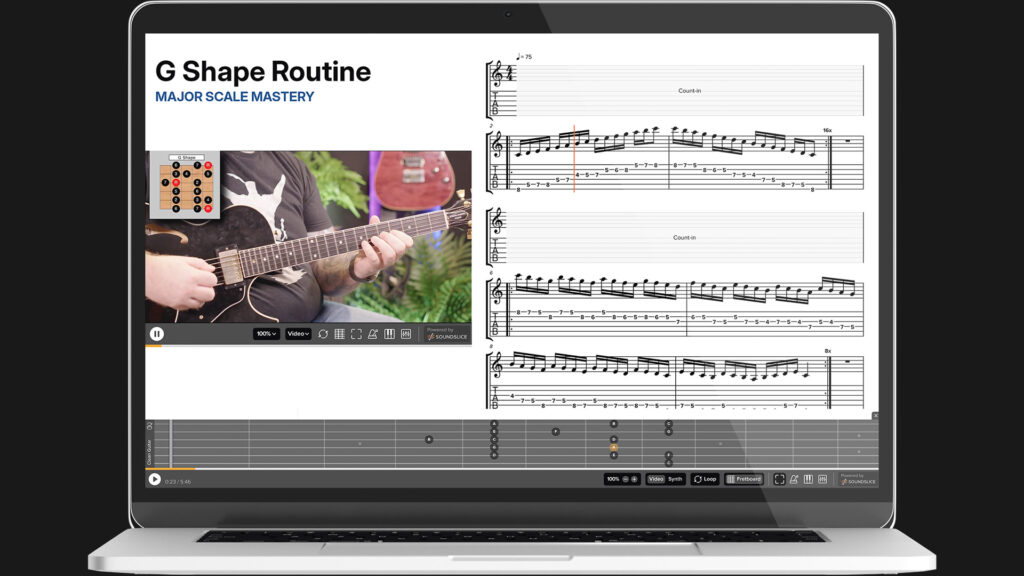
PRACTICE
Make the lessons stick with effective and structured routines and workouts.
+
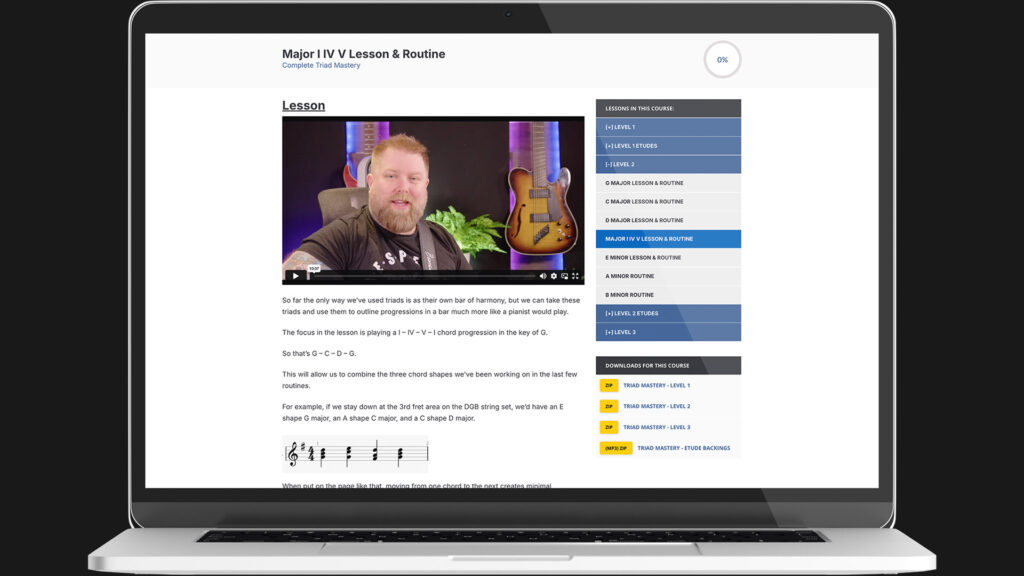
LEARN
Explore a library of in-depth courses & lessons on all kinds of topics
FEATURING SOUNDSLICE'S INNOVATIVE PLAYER FOR THE ULTIMATE LEARNING EXPERIENCE!
⬇️ Learn more about GPR by watching the video below ⬇️
HOW IT WORKS
What are Guided Practice Routines?
Instead of just watching lessons, you’ll play along in real time through guided sessions that combine focused instruction with hands-on practice. Each routine helps you develop the habits, timing, and fretboard fluency that lead to real improvement.
Whether you have 10 minutes or an hour, GPR helps you learn smarter, stay consistent, and make measurable progress every time you play.
What's Inside...
Our Latest Courses



Over 100 Hours of Content to Explore!
All of that, plus new Content Weekly!
💡 COURSE SPOTLIGHT 💡

The Triad Mastery Supercourse
Triads are the building blocks of rhythm, harmony, and fretboard fluency. Mastering them is the clearest path to confidence and control on the guitar.
This Course Features:
- Three Progressive Levels: Start with essential major & minor barre chord triads, move into closed voicings, then explore diminished, augmented, and more.
- Guided Practice Sessions: Learn the concept, then play along with me in real time so it actually sticks.
- 5 Musical Etudes: Apply what you learn in real musical contexts, complete with custom backing tracks.
- Full Fretboard Integration: Use our ACE system to unlock triads across the neck, in multiple keys and positions.
- Learn the Right Things, in the Right Order: No fluff, no overload, just a clear path to triad fluency that works.
If you want a practical, no-nonsense way to finally master triads, this is the place to start.
Access to this course is included with the membership.

YOUR INSTRUCTOR
About Levi Clay
Levi Clay was born in 1988 in Ipswich, UK. Although he came from a musical family, he focused on his academic studies until picking up the guitar at age 14. What began as a hobby quickly turned into a passion, and he devoted hours each day to studying books and magazines to hone his craft.
By the age of 16, Levi was already teaching others, having been approached by his high school teachers to work with their own children. Always a top-of-the-class student with a strong work ethic, this opportunity ignited a deep love for teaching and drove him to study even harder.
After taking his first formal classical guitar lessons in college, Levi moved to London in 2008 to pursue a degree in Popular Music Performance. During this time, he formed the band Hellcat Molly, performing across southern England while balancing his studies and working with mentors. By the time he graduated, Levi was transcribing music full-time and continued teaching, including leading courses at the Guitar Institute.
Levi went on to work with LickLibrary, releasing several instructional DVDs, and wrote the long-running Beyond Blues column for Premier Guitar magazine for five years. He later became an internationally best-selling author of his own instructional books—all while continuing to teach and transcribe for some of the biggest names in the music industry.
Now based in Scotland, Levi remains active as a performer, educator, and journalist, working as both a guitarist and pianist. His popular YouTube channel has attracted millions of views worldwide. With expertise spanning blues, rock, country, jazz, metal, soul, and more, Levi is a go-to resource for music education across styles.
CLIENTS
Levi has Completed Projects for...


Martin Taylor
Guitarist
His knowledge of the academic side of jazz has never left me needing more, as aside from his obvious understanding of the theoretical side of things, there’s a clear appreciation for the cultural side of jazz.
Frank Gambale
Guitarist
Levi clay is a professional, and his abilities are well documented. He is my first call transcriber, he is also a terrific musician in his own right.

Troy Grady
Cracking The Code
Levi is a professional transcriber, and an incredible guitarist and guitar educator, if you watched any of our interviews on the cracking the code site, it’s quite likely that Levi did those transcriptions.

– Levi Clay
YOU HAVE BEEN INVITED TO TRY...
Guided Practice Routines!
Get instant access to our proven practice routines, exclusive courses, lessons, transcriptions, events, and more to help you achieve real results.
Cancel anytime during your free trial and you won’t be charged.
After 7 days, your membership will begin automatically, but you’ll still be protected by our 14-Day Money-Back Guarantee.
No risk. Just results.
FAQ
Common questions
Guided Practice Routines (GPRs) are the missing link between success and failure in the age of digital guitar education.
By combining education and implementation in one package, they guarantee faster skill development than any other method.
A typical GPR consists of two parts: a lesson or instructional component and a play-along workout routine that solidifies the lesson content. This structure allows you to learn, practice, and apply everything within a single session.
With an emphasis on clear, direct instruction combined with effective practice strategies, Guided Practice Routines provide the exact kind of insight and accountability that was previously only possible through one-to-one lessons.
With over 100 hours of video content, we offer 10 courses and 150 legacy lessons, with new content added every week.
You’ll also get access to Levi’s extensive YouTube transcription library, featuring Guitar Pro and PDF files.
New content is added weekly, including individual workout routines, courses and course modules, transcriptions, and live events.
We offer a seven-day refund policy so you can sign up with confidence. If you’re not completely satisfied with your membership, simply contact us within seven days of your purchase and we’ll issue a full refund—no questions asked.
To request a refund, please email support@guidedpracticeroutines.com with your order details. We’re committed to ensuring you have a great experience with our courses.
Still have questions?
Get in Touch...
or email us at support@guidedpracticeroutines.com