Pentatonic sequences are the quickest way I know to make the minor pentatonic scale stop sounding like a scale. Instead of running straight up and down the pattern, you take a small melodic idea (six notes, four notes, five notes, a low note and a high note) and repeat it from different starting points. You’re playing exactly the same notes, but it sounds like music, it trains your picking, and it shows you shapes inside the pattern you never noticed before.
Here are the sequences from my E-Shape Sequencing routine, step by step, with the exact exercises from the lesson.
Why bother with sequences?
The routine before this one in the course is pure scale running: up the pattern, down the pattern. That’s important, but there’s nothing very musical about it, and I wanted to give you ways of breaking the pattern up for two reasons.
First, it makes scale practice feel less like scale practice. These ideas sound more musical to me, and anything that sounds musical keeps me practicing for longer. Second, it shows you that a scale pattern isn’t only a scale pattern. You can pull little melodic cells out of it, and those cells are where licks come from.
What is a sequence, exactly?
A sequence is where you play one musical idea and then repeat it in a slightly different way, so the listener can still hear the pattern. Think of numbers. “1 2 3 4” is a group of four. If I imitate it, I get “1 2 3 4, 2 3 4 5, 3 4 5 6, 4 5 6 7”. You can hear the relationship straight away.
If I said “1 2 3 4, 7 2 3 6” instead, it’s still groups of four numbers, but there’s no relationship between them. That’s the difference. A sequence is simply a pattern your ear can follow.
The scale: C minor pentatonic in the E shape
Everything in this routine uses one pattern: C minor pentatonic in the E shape, with the root on the 8th fret of the low E string. If you know the pattern already, great. If not, learn it first, because every sequence below assumes your fingers know where the notes are.
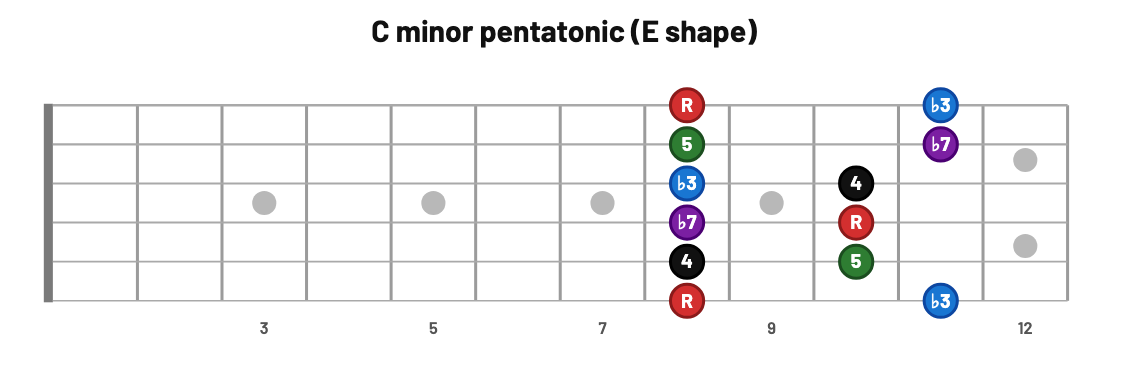
C minor pentatonic in the E shape.
I’m not going to make you run every sequence through every pentatonic shape in this lesson. If we did that, we’d be here for ten weeks. Learn them here, then apply them to the other shapes as you learn those.
Sixes: the Zakk Wylde sequence
The first one is a classic Zakk Wylde-ism. Don’t worry, we’re not playing it at Zakk’s speed. Start on the lowest note of the pattern and play six notes going up. Then go back to the lowest note on the A string and play six more. Do the same from the D string, then the G string, and finish on the root.
Exercise 1: Ascending sixes
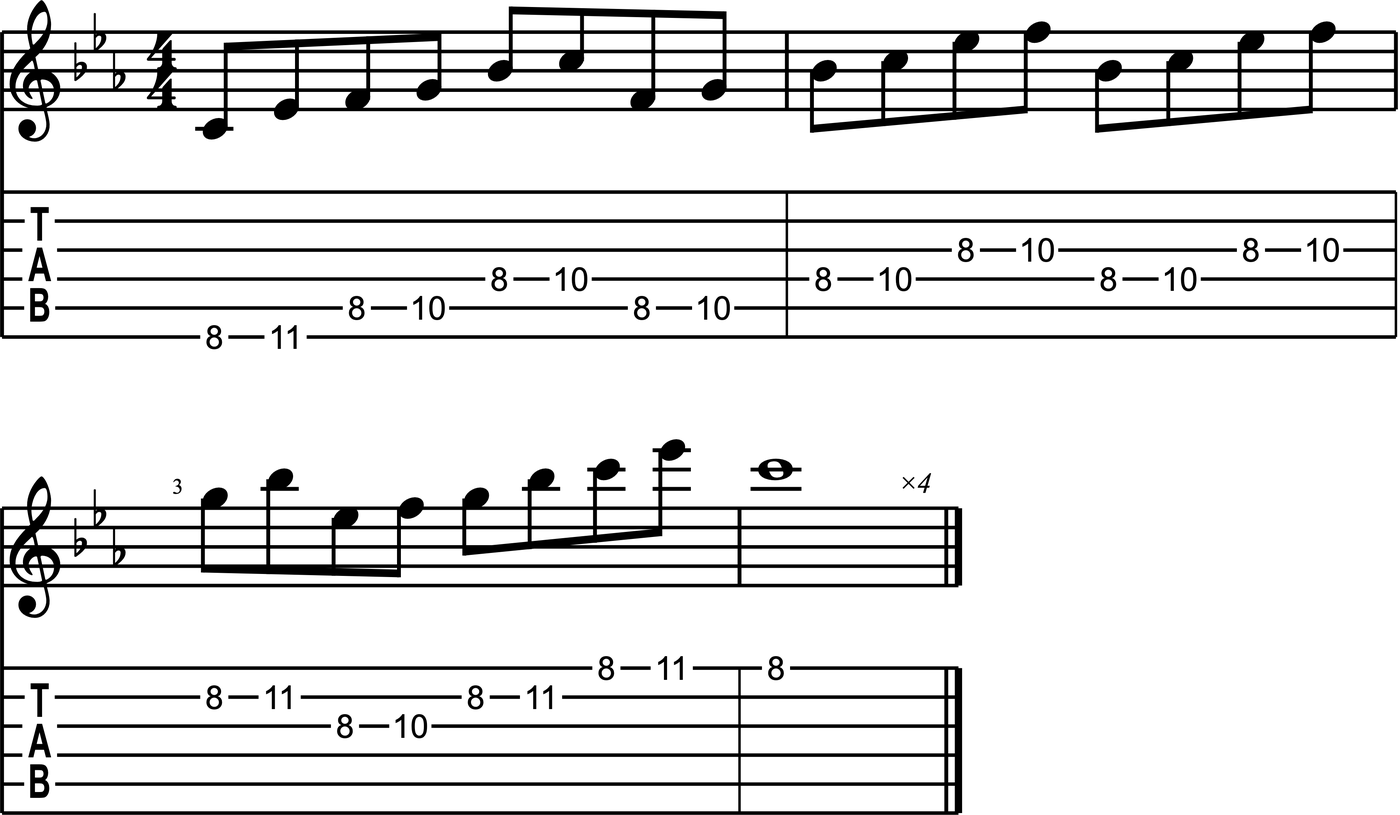
Exercise 1: ascending sixes
Here I play Exercise 1 along with the routine at 120 bpm: six notes up from the low E, A, D and G strings, finishing on the root (from the E-Shape Sequencing routine).
Then turn it around. Start on the highest note and play six notes down, then six down from the top of the B string, the G string and the D string, and land on the root. I’ve written that last root on the low E string, but you could play it on the D string instead, which is a very Eric Johnson move.
Exercise 2: Descending sixes
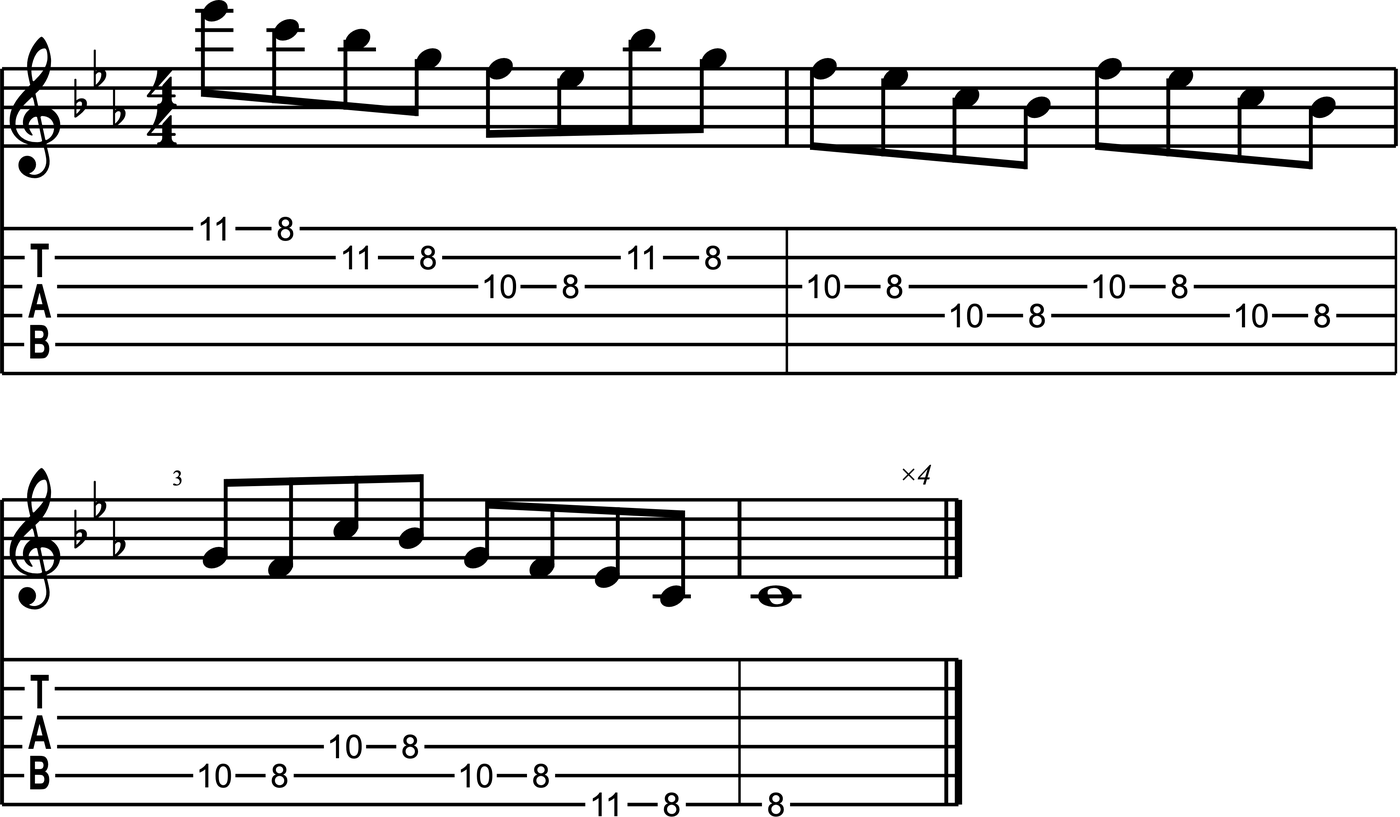
Why sixes sound more musical
Here’s the trick. We’re grouping the notes in sixes, but the bar has four beats of eighth notes. A six-note idea doesn’t fit in a bar, so every time it repeats, it starts somewhere different in the bar instead of on the downbeat.
Count it as “1 2 3 4 5 6” and it sounds like a scale exercise. Count it as “1 and 2 and 3 and 4 and” over the top and you’ll hear the motif rolling across the beat. It’s a real mind-bender to count, but that offset is what makes it sound cool.
It’s also great picking practice. With sixes, every string change comes after an upstroke, so it suits a downward pick slant nicely. Take your time with it.
Groups of four
Next, an ascending group of four. Go to the bottom of the pattern and play four notes up. Then start on the second note of the pattern and play four up, then the third note, then the fourth, and keep going. In the routine I stop on the flat 7 rather than going all the way to the top, just so it fits in the bar.
In the video you’ll hear me play it with a triplet feel, but that’s not how it’s written. Play straight eighth notes for the exercise.
Exercise 3: Ascending groups of four
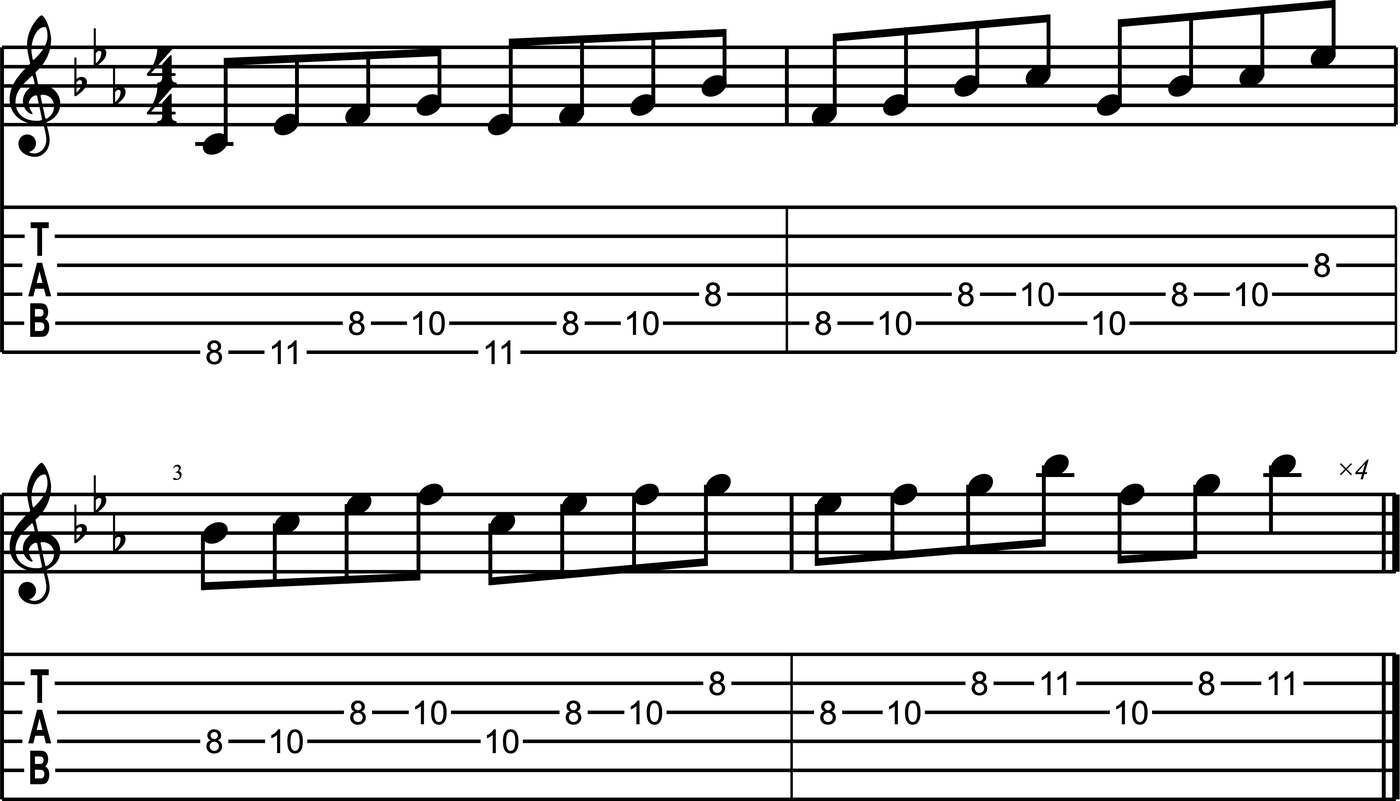
I love this one as a sequence, and you can spend a lot of time with it. It’s different from the sixes for your picking hand. With alternate picking, some string changes now come after a downstroke and some after an upstroke, so you have to be a more articulate picker to pull it off. And the best way to become that articulate picker is to work on this sequence.
Once you have it going up, the routine takes exactly the same idea back down. It’s not the hardest thing in the world. You just have to give it a decent amount of time.
Groups of five
I like this sequence a lot. To play the fives the way I like them, start with a group of four from the root: C, E♭, F, G. Then reach back to the E♭, the flat 3, and play five notes up. Then come over to the G on the 10th fret of the A string and play five up, then five from the 10th fret of the D string, then the 10th fret of the G string, and that takes you to the root.
Exercise 5: Groups of five
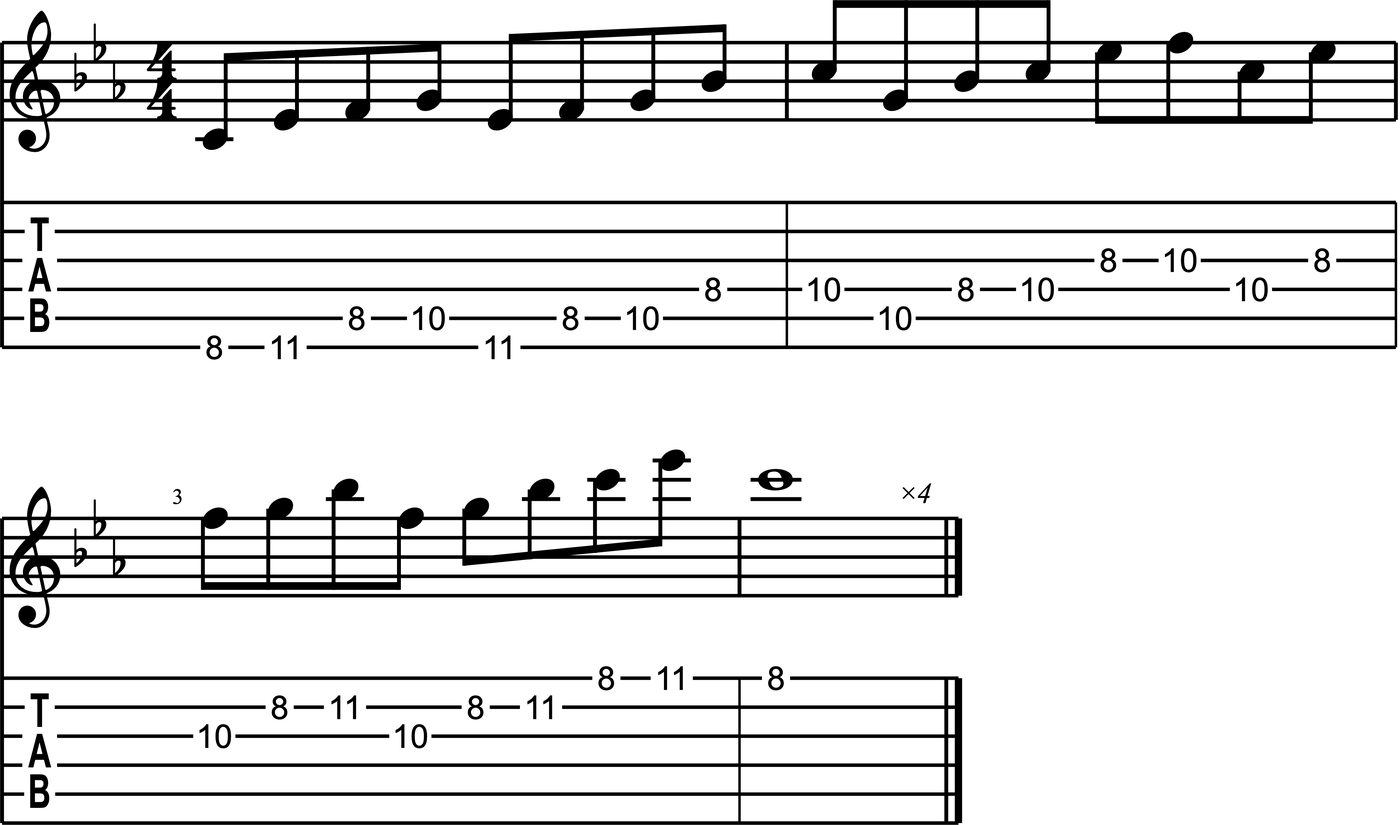
Five doesn’t fit into four either, so the start of each group keeps shifting around the bar. That’s why it sounds so good. If you watch my fingers in the lesson you’ll see me using separate fingers a lot, and once I add some economy picking it gets quick. Sometimes I play this in time in a rock context, and sometimes I just let it float over the beat as a blur of fives.
The routine then plays the fives descending. It’s that cascading sound, like someone falling down the stairs, and it’s very Eric Johnson. He uses economy picking to play it really fast, but that’s not the goal here. Take it slowly until it feels natural.
Low note, high note: breaking the pattern up
The last group of exercises looks at the pattern differently. Every string in the pentatonic pattern has two notes: a low one and a high one. So instead of playing across each string, we play two low notes on neighboring strings, then two high notes.
You’ll need a lot of finger rolling to pull it off, but it’s a great sound. It’s more modern and more vertical than running the scale, and to my ears it’s a lot cooler.
Exercise 7: Low note, high note
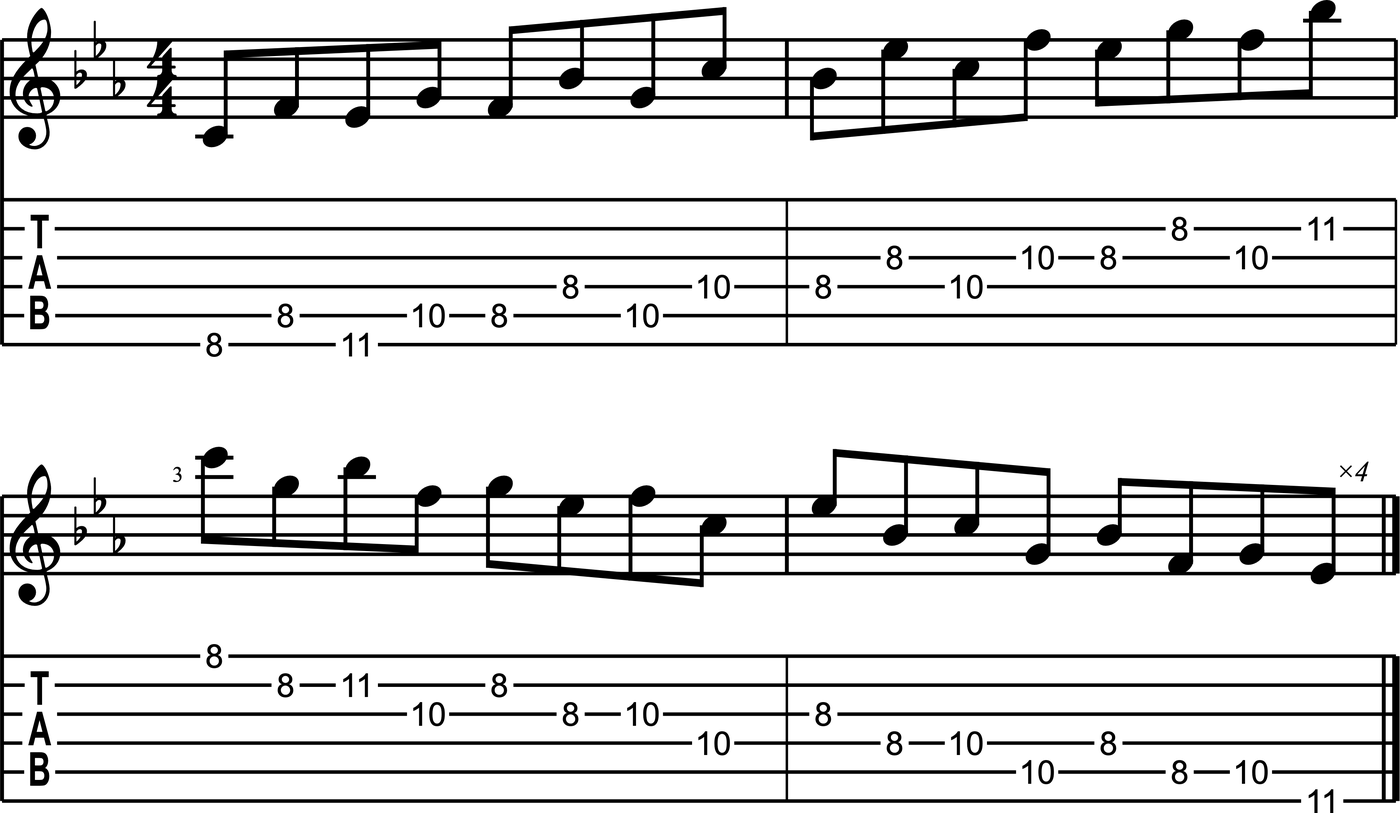
From there the routine takes the idea further. One exercise mixes ascending and descending pairs, and another takes it to its logical extreme with low notes across three strings, then high notes across three strings. That one isn’t very bluesy, but it’s great cross-picking practice, and it’s really a visualization exercise. I do exercises like this to break the pentatonic patterns into fragments.
The final exercise uses groups of three, but now it’s one low note followed by two high notes. Go down through the pattern, end on the root, then come back up the same way.
Exercise 10: One low note, two high notes
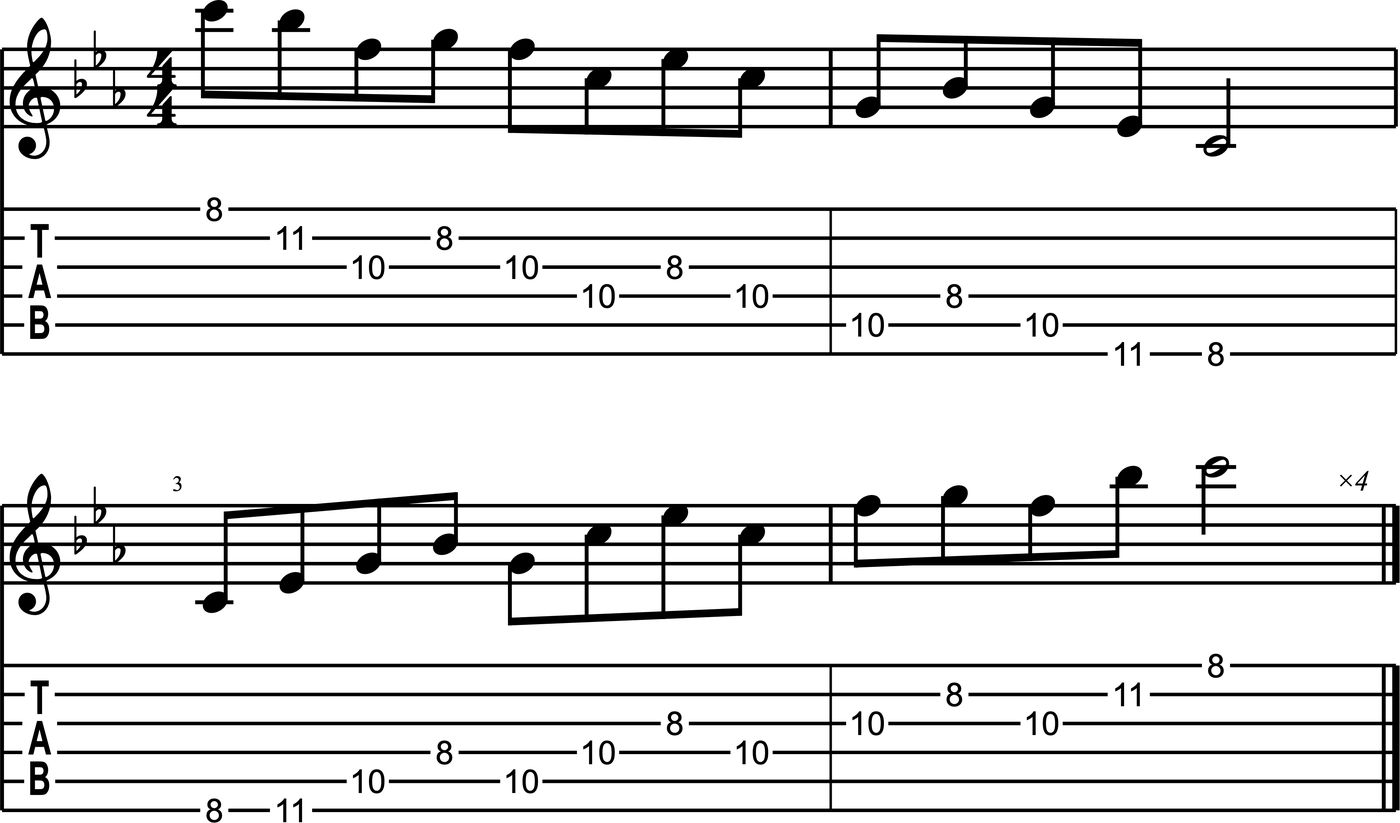
Played as chords, that would sound strange. Played as a melody, it breaks the scale up in a way you wouldn’t normally play it, which is exactly the point.
How to practice pentatonic sequences
- Go slowly. The routine runs at 120 bpm in eighth notes, and each exercise repeats four times. All ten exercises take about six minutes. Speed isn’t the goal. Getting the sequence to feel natural is.
- Count in fours, not sixes or fives. Feeling where each group lands in the bar is what turns a scale exercise into something musical.
- Watch your string changes. Each sequence crosses strings on a different stroke. That’s the picking workout, so don’t rush through it.
- Take them to the other shapes. When you learn C minor pentatonic in the C shape, apply the same sequences there. Some of them get really tricky. I tried one in the lesson and it’s something I can see in my mind but definitely need to practice, with good fingerings. That’s how you find the gaps and fix them.
This routine comes from my Minor Pentatonic Workout course, which is part of The Ultimate Pentatonic Workout: minor pentatonic in all five shapes and all 12 keys, plus major pentatonic in five shapes, with 18 guided routines you press play on and practice along with me. It’s all part of a GPR membership too.
Where next? If you want to see the chords hiding inside every pentatonic box, start with the three major triad shapes.