To play the major scale in thirds, take the first note of the scale, skip the next one and play the one after it, then do the same from the second note, and keep going. In C major that’s C to E, D to F, E to G, F to A and so on, all the way up the position and back down. Once you can do that in one shape, you take the same idea through all five shapes of the scale, and that’s exactly what this routine does.
Of all the intervallic sequences, diatonic thirds are the one I find most musical: fretboard practice and musical practice at the same time. Here’s how I teach them, with the exercises straight from the routine.
What is the major scale in thirds?
A diatonic third is the distance from one note of the scale to the note two steps above it. Count one, two, three: C, D, E. So C to E is a diatonic third. We play C, skip D and play E. Then we play D, skip E and play F.
That’s the theoretical way of explaining it: take a note, skip a note. What it really is, once it’s under your fingers, is a pattern applied to a scale fingering. As long as you can see all the notes of the position, you learn what it feels like to apply that pattern.
Which is why there’s one thing you need before you start: the major scale itself, in all five positions. If any of those shapes are still shaky, go back and spend time on them first. This routine is about applying an idea to the scale, and you can’t apply it to notes you can’t see yet.
Diatonic thirds in the A shape
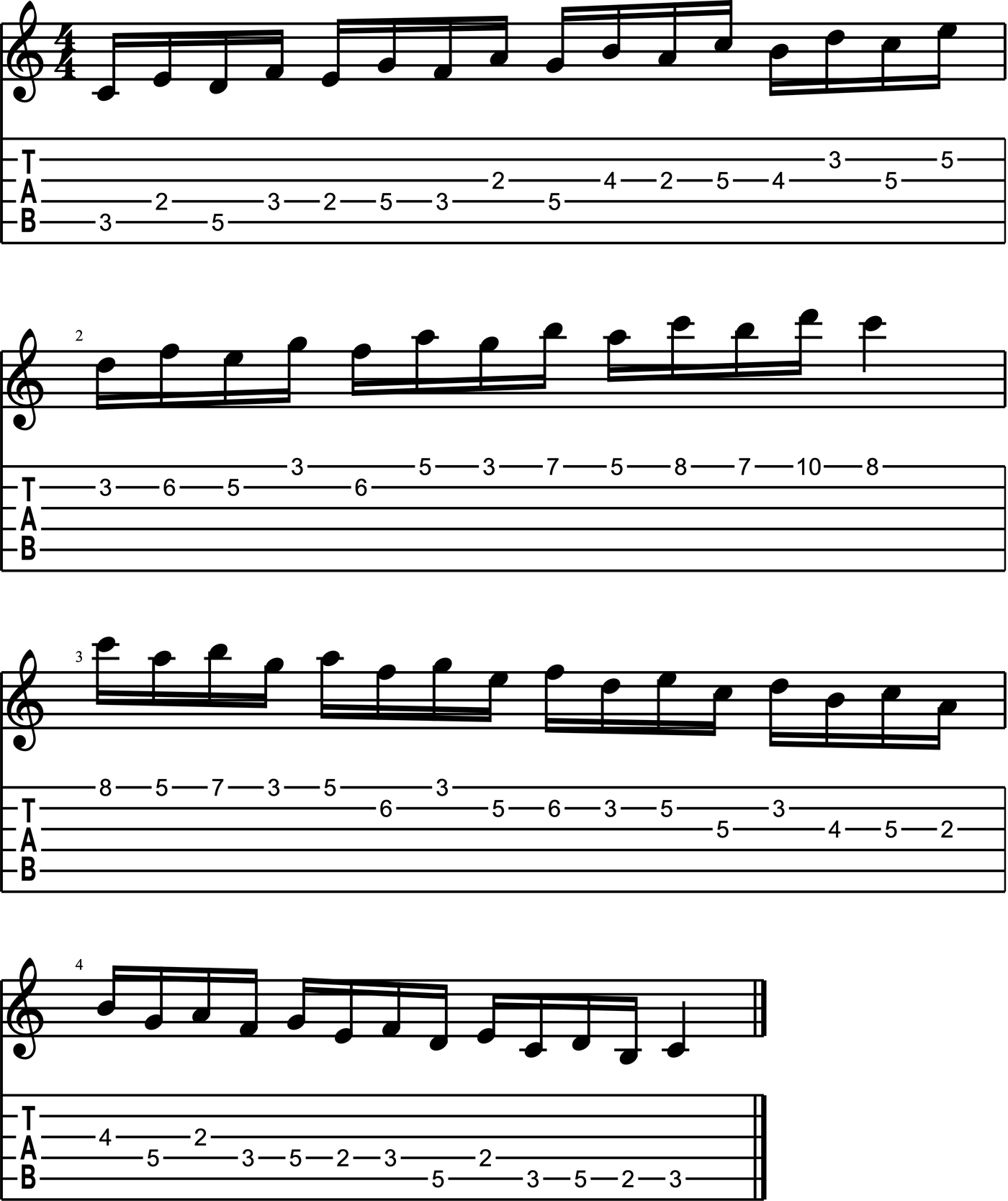
We start in the A shape of C major, with the root on the 3rd fret of the A string. Here are all the notes Exercise 1 uses. Notice that the run reaches up the high E string at the top, so it can finish on the high C and D.

C major, A shape: every note in Exercise 1, labeled by scale degree.
Now look at how the pattern falls on the strings. The first two notes sit on adjacent strings, and so do the next two. When a string has three notes on it, as the D string does here, the third is just the outer two notes on that string: the lowest note in the pattern and the highest.
Here’s a trick for getting the sound in your ears. Where the two notes of a third are on adjacent strings, play them together as a double stop. Where they fall on the same string, alternate them. So it goes double stop, double stop, alternate, and so on up the position. Take your time with it like that until it feels quite natural, then take the pauses out and play the notes one at a time.
Coming down, start on the high C so you have the full position in: C down to A, B down to G, A down to F, G down to E, and so on.
Exercise 1: C major in 3rds, A shape (root on the A string, 3rd fret), up and back down
Take the 3rds sequence through all five shapes
Rather than a separate video for each position, we learn the sequence as a concept and apply it to all five positions in one routine: from the A shape up to the G shape, then the E, D and C shapes. Before each one, remind yourself what the scale looks like, then apply the sequence.
The G shape
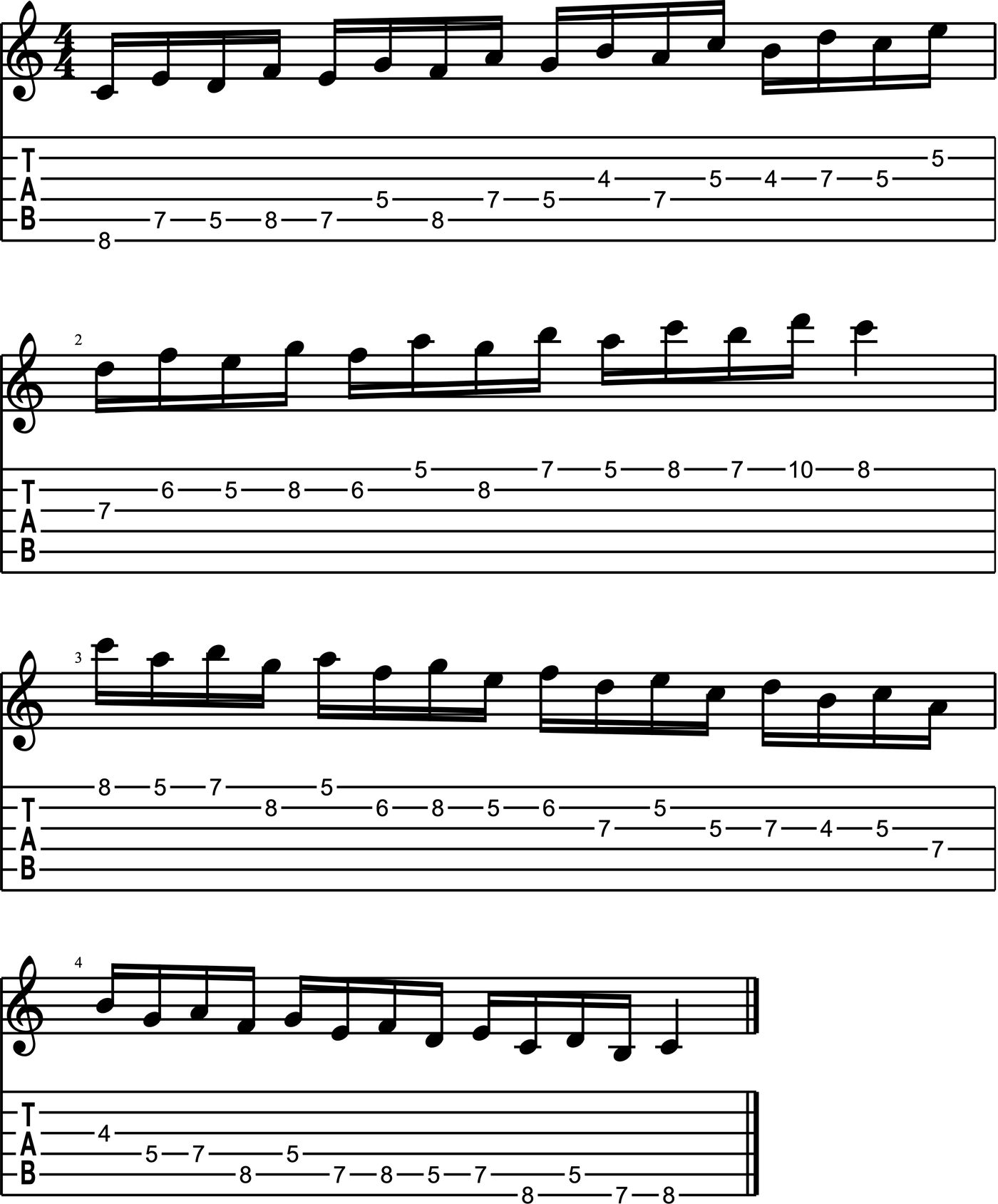
The G shape starts on the C at the 8th fret of the low E string, under your pinky. You might find a couple of little trouble spots in this one. Going up, plan your fingering for the G on the D string (5th fret) so you can still get up to the B on the G string. Coming down, play the A on the D string (7th fret) with your third finger, not your pinky. If you use the pinky there, it’s hard to get to the F on the A string.
I made exactly that mistake in the lesson, more than once. It happens. Just notice it and fix it the next time around.
Exercise 2: C major in 3rds, G shape (root on the low E string, 8th fret, pinky)
The E shape
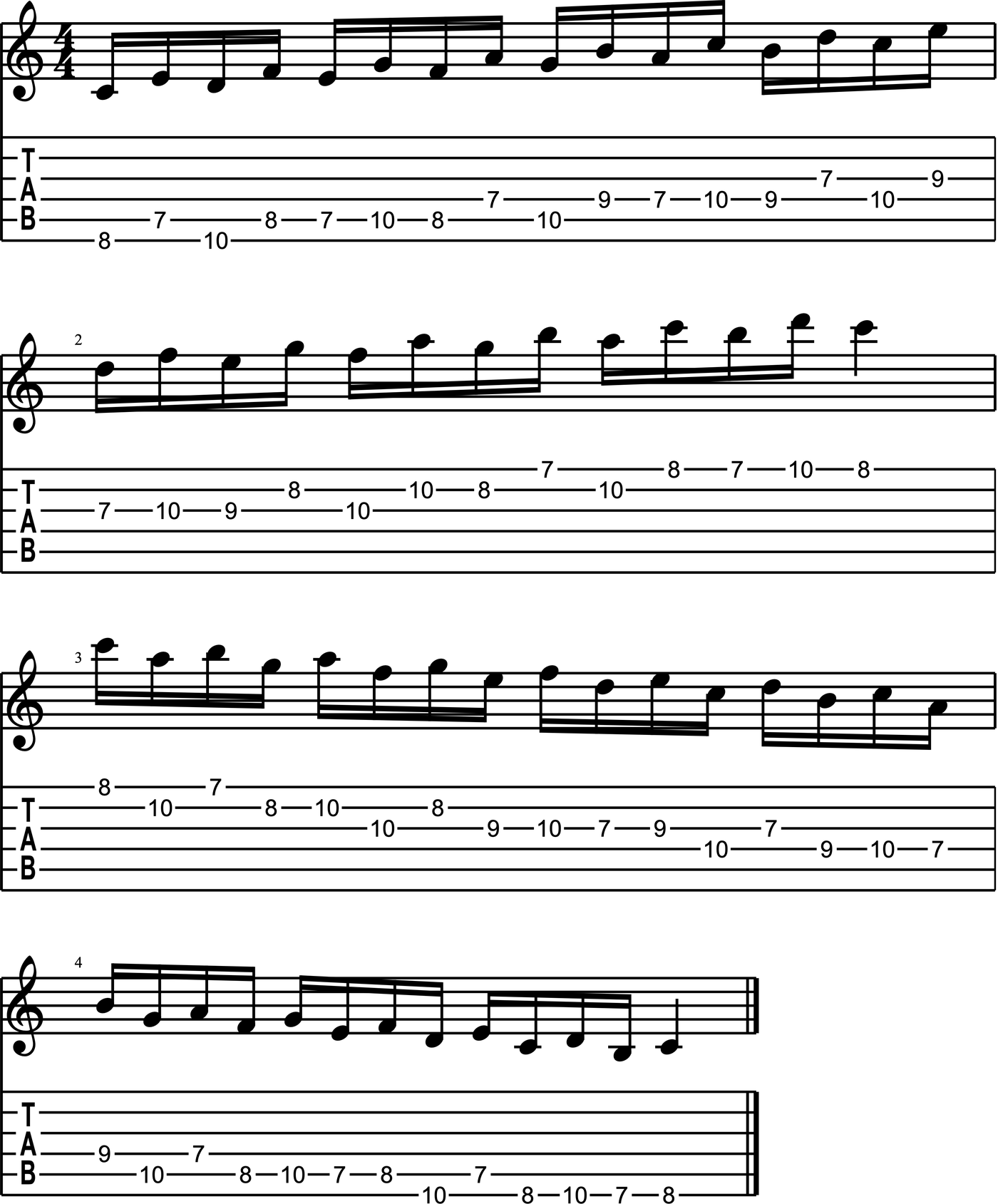
Same root, same C on the 8th fret of the low E string, but now it’s the E shape, so the position sits from the 7th fret to the 10th. Apply the sequence the same way, up and back down.
Exercise 3: C major in 3rds, E shape (root on the low E string, 8th fret)
The D shape: start on the third
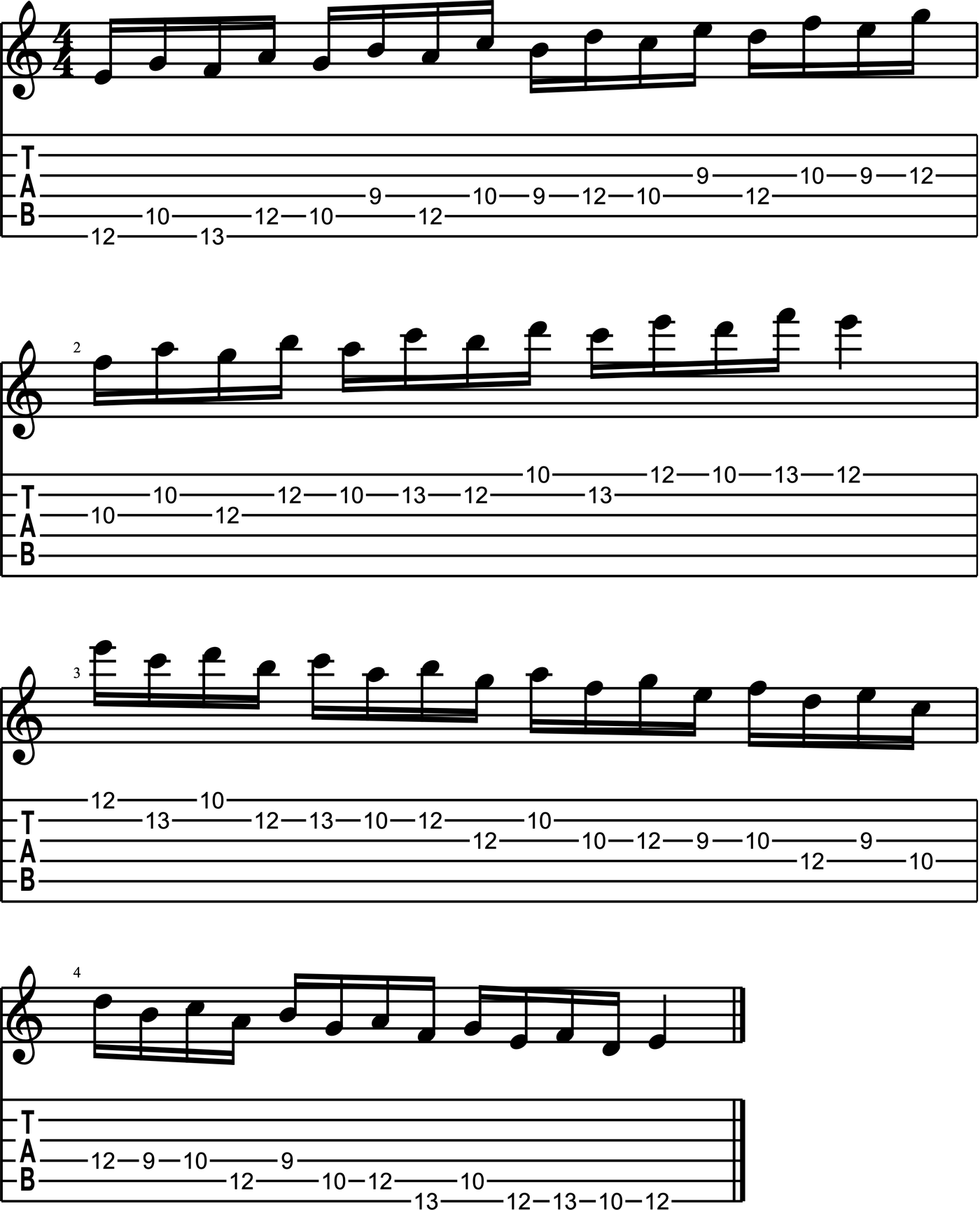
In the D shape I don’t want to start on the root. If I do, I run out of notes I can play before the bar is over. So we start on E instead. E is in our C chord: it’s the third. Start on the E at the 12th fret of the low E string, go up and finish on the E on the top string, then come back down. There’s a slightly tricky fingering on the way down, so go slowly at first.
Exercise 4: C major in 3rds, D shape, starting on the third (E, 12th fret)
The C shape: start on E, walk up to the root
The C shape starts on E as well. If you start on C here, you end up having to play all the top notes on the high E string to finish. Starting on E, you finish on the E at the top. Coming down, start on the G, and once you hit the G at the bottom, walk up the scale to the C root note.
The written exercise then goes around again starting from the C on the A string, and you’ll see exactly what I mean: the top of the run climbs the high E string all the way to the 22nd fret.
Exercise 5: C major in 3rds, C shape, starting on E, then again from C
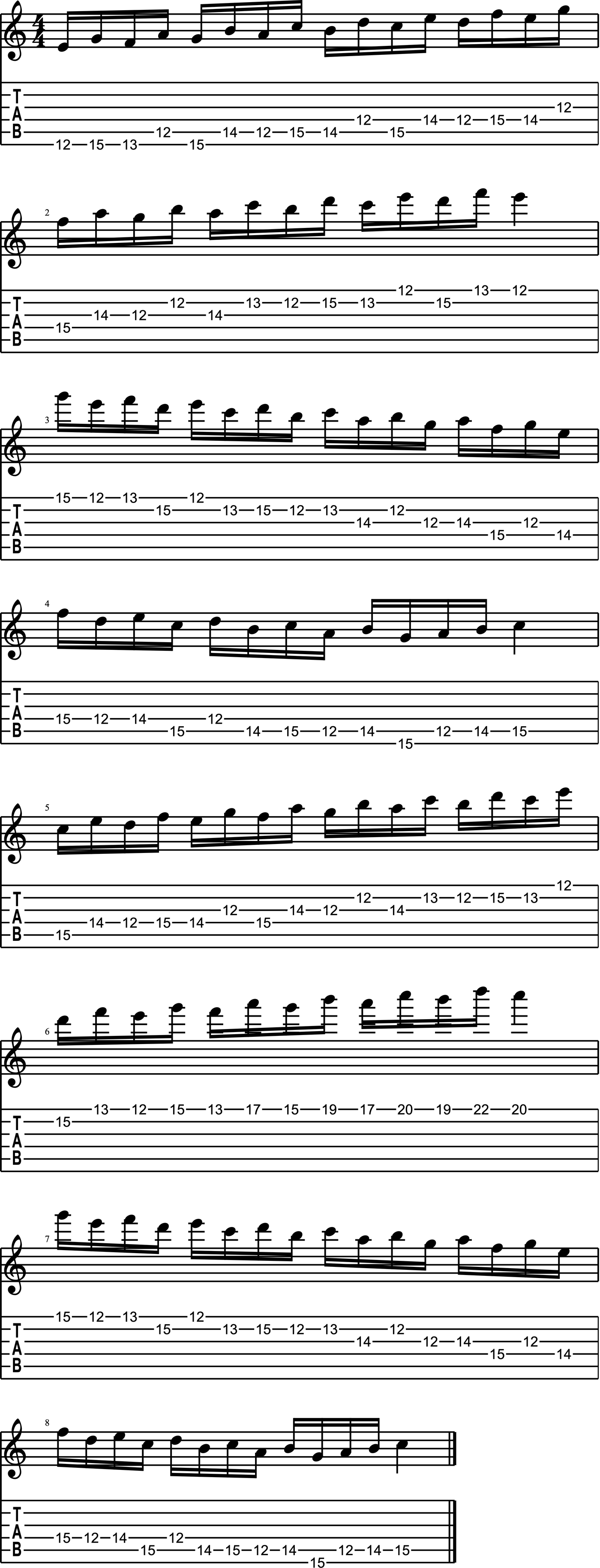
The 3rds sequence
Here I play the routine through at a medium tempo without the repeats, starting in the A shape and moving up the neck through the shapes (from the 3rds Sequence lesson).
Think in sound, not in fingerings
I can’t stress this enough: don’t try to brute force this as a memorization task. “This finger goes on this fret, then this finger goes on this fret.” If you try to learn everything on the guitar like that, you’re filling your brain with an inconceivably large number of things to remember. We don’t want that.
When I play this, I’m not thinking pitch names. I’m not even thinking intervals. Try saying the scale degrees out loud while you play it and you’ll see how quickly that falls apart. I’m thinking of a melodic cell and applying it within the framework of the scale.
The beauty of it is that the idea moves. If I play the sequence across the whole neck, it comes out a little different every time. The melody is the same, but where I finger the notes changes, because I’m not playing a memorized fingering. I’m hearing the idea and applying it. In practice we keep it to one position at a time, but that’s the skill you’re building.
How to practice the 3rds routine
- Know the five shapes first. This routine assumes you can already see the C major scale in the A, G, E, D and C shapes.
- Get the sound before the speed. Use the double stop trick in each new shape until the pattern feels natural, then take the pauses out.
- Play each shape up and down twice. In the routine, Exercises 1 to 4 each repeat, and Exercise 5 is written out in full. The whole thing runs at 75 bpm in sixteenth notes, and it’s over in just a couple of minutes.
- Fix fingerings as you find them. The G shape and the D shape are where the awkward spots are. Slow down there rather than everywhere.
- Then connect them. The real challenge is playing all five in sequence without stopping to think.
Where the 3rds sequence takes you next
Once your brain understands how the sequence is played, you’ll find it works no matter the scale fingering or the scale pattern. In the lesson I switch to C Phrygian dominant and play the same sequence without thinking about it, because I’m just applying the same idea to a different scale. I even try it on the whole tone scale. The fingerings are harder there, but the sequence still applies.
If you like this kind of practice, the same thinking works on smaller scales too, like the pentatonic. If you’re itching to get into modes, the major scale is the place to build from first. And if you want another way to see the neck through the E, C and A shapes, start with the three triad shapes I teach first.
The 3rds sequence is one lesson from Major Scale Mastery, where we learn the major scale in all five shapes, then play it in all 12 keys and turn it into melodies, across 12 guided routines.